
SDIC Unattended Automatic Vehicle Volume Measurement Project
Project Background
SDIC salt‑lake mining area features large‑scale production and frequent material transshipment. A large number of dump trucks are responsible for ore outward transportation. Located in northwest Gobi desert, the site suffers from severe wind‑sand and saline‑alkali conditions with huge day‑night temperature difference. Traditional weighbridge solution requires trucks to stop and queue for weighing with on‑site attendants, leading to low traffic efficiency and high maintenance cost caused by saline‑alkali corrosion. The mine requires a truly unattended automatic vehicle volume measurement system without weighbridge.
Project Pain Points
- Harsh Gobi saline‑alkali environment: heavy dust, wind and sharp temperature variation, demanding high‑protection‑grade hardware.
- Low efficiency of weighbridge mode: trucks must stop and queue, causing congestion at site gate.
- High labor cost: 24‑hour on‑site attendants for weighbridge operation.
- Cumbersome maintenance: weighbridge steel structures are easily corroded under saline‑alkali condition, requiring frequent calibration and repair.
- Poor data linkage: hard to bind weighing records with snapshot evidence for traceability.
Solution
Chongqing Jinyun Machinery deployed Unattended Automatic Vehicle Load Volume Measurement System for SDIC salt‑lake mine. Gantry‑style detection structure is built and linked with intelligent barrier gate. Trucks pass at low speed without stopping or weighbridge. The whole workflow including license‑plate recognition, AI volume calculation, snapshot archiving and automatic gate release is completed for full unattended operation.
Hardware Advantages
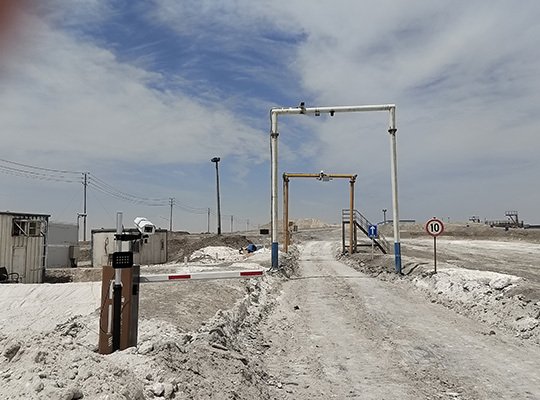
‑ High‑protection industrial hardware, resistant to saline‑alkali dust, strong wind and extreme temperature variation, supporting stable 7×24‑hour continuous operation.
‑ Fast‑erected gantry frame, no weighbridge foundation construction required, reducing construction workload and cycle.
‑ Linked with intelligent barrier gate for automatic release after detection, forming closed‑loop management.
‑ Multi‑sensor fusion technology, anti‑interference against dust and strong sunlight, realizing accurate volume calculation for uneven ore piles.
Core Software Functions
- Volume measurement upon passing: AI calculates actual ore‑loading volume while trucks drive through gantry checkpoint, acting as alternative metering reference for weighbridge.
- License‑plate recognition & barrier‑gate linkage: identify plate number, verify vehicle permission and lift gate automatically after detection for unattended operation.
- Multi‑angle snapshot archiving: bind license plate, timestamp, measured volume and vehicle photos for file storage.
- Cloud management platform: remote real‑time data viewing, auto‑generated transport reports with export function.
- Abnormity alarm log: mark over‑height or abnormal‑loading vehicles for later review.
On‑site Application Effect
After system deployment, trucks finish volume measurement, identity verification and automatic gate release without stopping and queuing.
Dependence on physical weighbridge and weigh‑house attendants are eliminated. It solves the problem of easy corrosion and frequent maintenance of weighbridge under saline‑alkali Gobi environment. Traffic efficiency at mine gate is greatly improved without vehicle congestion.
All transport data and on‑site images are stored in cloud storage with complete traceability, realizing digital unattended transformation for ore transshipment.
Customer Benefits
- Efficiency & cost optimization: Remove weigh‑house staffing, eliminate gate queuing and reduce later‑stage equipment maintenance cost.
- Harsh‑environment adaptability: Industrial hardware withstands saline‑alkali, wind and extreme temperature to lower failure rate.
- Full unattended closed loop: Integrate volume measurement, plate recognition and barrier‑gate control with zero manual intervention.
- Complete traceability: Volume data, plate info and snapshots are bound one‑to‑one as valid evidence.
- Remote supervision: Check transport statistics remotely to support production scheduling and accounting.